
Sites and Warehouses (LOC)
The loc submodule of inv owns the physical-location reference data for inventory: sites, warehouses inside a site, locations inside a warehouse, the location-types that classify those locations, and the per-(warehouse, container-type) capacity rows. It depends on com.org for the company a site belongs to, on com.cal for the site’s working calendar, on com.log for the weight UoM, on com.par for the warehouse’s delivery address, and on inv.cnt for the container types pinned to location types and warehouse capacity. It also exposes the HasInventoryTransaction extension interface that every inventory-transaction row across the ERP implements.
Concepts
SiteA physical location of operations — typically a plant or distribution centre — owned by a finance company. Carries the working calendar and the default receipt/delivery warehouses.
WarehouseA storage facility within a site. Has a type (internal/transit/external) and a delivery address.
Warehouse LocationA storage spot inside a warehouse — a rack, a bay, a slot — classified by its
LocationType.Location TypeA reference type that names a class of storage spot (receipt, bulk, pick, work-in-progress, despatch). Drives which container types can sit in a location of this type.
Location Type ContainerA link row that says which
ContainerTyperows are allowed in a givenLocationType.Warehouse CapacityA per-(warehouse, container-type) capacity figure: how many bulk and pick units of the container type the warehouse can hold.
Inventory Posting TypeA binary classifier that says whether an inventory operation is a forward post or its reversal — used by the rollback flow to undo what a forward post did.
Inventory TransactionA common shape implemented by every entity that posts to inventory: when, where, who, what, and the optional external UoM. Other modules consume this through the
HasInventoryTransactioninterface.
Entities
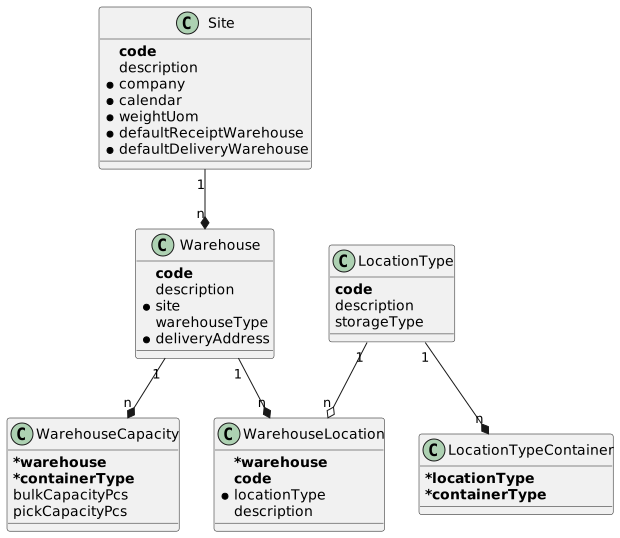
Site (Site)
A physical operations location.
| Field | Description |
|---|---|
| Business key (up to 4 characters). |
| Human-readable name. |
| Owning finance company. |
| Working calendar. |
| Default weight UoM at the site. |
| Optional default warehouse used for inbound goods. |
| Optional default warehouse used for outbound goods. |
Warehouse (Warehouse)
A storage facility.
| Field | Description |
|---|---|
| Business key (up to 8 characters). |
| Human-readable name. |
| Owning site. |
| Internal, transit, or external — see Warehouse Types below. Default |
| The delivery address attached to the warehouse. |
Warehouse Types (WarehouseType)
| Code | Name | Meaning |
|---|---|---|
| Internal | A facility owned and operated by the company. |
| Transit | A transit/in-flight location for goods between facilities. |
| External | A third-party facility (3PL, supplier, …). |
Warehouse Location (WarehouseLocation)
A storage spot inside a warehouse.
| Field | Description |
|---|---|
| Owning warehouse (composite business key with |
| Location code (a |
| The class of spot. |
| Optional free-form description. |
Location Type (LocationType)
A class of storage spot.
| Field | Description |
|---|---|
| Business key (up to 6 characters). |
| Human-readable name. |
| What the spot is for — see Storage Types below. |
Storage Types (StorageType)
| Code | Name | Meaning |
|---|---|---|
| Receipt | Inbound goods sit here on arrival. |
| Bulk | Bulk-stored stock. |
| Pick | Pickable stock for outbound. |
| Work in process | Stock currently being worked on. |
| Despatch | Outbound goods staging. |
Location Roles (LocationRole)
| Code | Name | Meaning |
|---|---|---|
| Receipt | Used for inbound flows. |
| Stock | Used for stocking. |
| Expedition | Used for outbound flows. |
Location Type Container (LocationTypeContainer)
A link between a location type and a container type that may sit in it.
| Field | Description |
|---|---|
| Owning location type (composite business key with |
| The container type allowed in the location. |
Warehouse Capacity (WarehouseCapacity)
A per-(warehouse, container-type) capacity figure.
| Field | Description |
|---|---|
| Owning warehouse (composite business key with |
| The container type the figures apply to. |
| Bulk capacity in pieces. |
| Optional pick capacity in pieces. |
Functionality
Capacity and location lookup
INV_LOC_QueryApi exposes two thin lookups: warehouse capacity for a (warehouse, container type) pair, and a warehouse location by (warehouse, location code). Both return null when not found — callers decide whether absence is an error.
Inventory-transaction extension
HasInventoryTransaction is the seam every inventory-touching entity in the ERP implements. It standardises the question "what does this row do to inventory?" — exposing the transaction type, address, optional warehouse location, partner, inventory unit, pieces, internal quantity, and optional external UoM/quantity. Modules like inv.unt, acc.jrn, and the trade modules code against this interface so they don’t depend on the concrete entities.
Posting type
InventoryPostingType is a small enum (POST_TO_INVENTORY / UNDO_POST_TO_INVENTORY) used by inventory-posting flows to indicate whether the operation is a forward post or its reversal. The reversal flag is exposed via isReversal().
Public API
INV_LOC_QueryApi
Read-side facade.
| Method | Description |
|---|---|
| Capacity row for the pair, or |
| Warehouse location by code, or |
INV_LOC_CommandApi
This submodule does not provide a command API class. Sites, warehouses, locations, location types, and capacity rows are maintained through the standard CRUD pages.
HasInventoryTransaction extension
Cross-module seam every inventory-posting entity implements. Methods: getInventoryTransactionType, getInventoryAddress, getWarehouseLocation, getPartner, getInventoryUnit, getQuantityPcs, getQuantityInt, getQuantityUom, getQuantityExt.
ViewModel actions
The submodule defines view models for Site, Warehouse, WarehouseLocation, LocationType, LocationTypeContainer, and WarehouseCapacity but does not declare any custom UI actions.