
Dynamic Forms (FRM)
The frm submodule of sys provides a metadata-driven form and grid system. Administrators define reusable typed properties, group them into schemas, lay them out as forms or grids, and store user-entered data as JSON-backed records that conform to those schemas. It is the backing model for free-form business documents (brand, persona, audience, equipment, inspection, campaign, …) and exposes its schemas to the Venlo Frame as DictionarySchema instances so the rest of the framework can render and validate values uniformly.
Concepts
PropertyA reusable typed value descriptor (text, number, date, enumerate, …). Properties carry the rules that govern a value: string length and case, decimal precision/scale/rounding, default UI dimensions, optional unit of measure, and — for enumerate properties — the allowed options.
SchemaThe structural definition of a record type: an ordered list of fields, each bound to a
Property. A schema corresponds to oneDictionarySchemaat runtime.Schema FieldA named slot inside a schema. It refers to a
Propertyfor typing rules and adds schema-specific concerns: line order, label, tooltip, mandatory/optional status, and an optional LLM-assist prompt used to fill the field automatically.FormA user-interface layout for entering data into a schema. A form is an ordered tree of sections; each section contains form fields that point at schema fields.
GridA user-interface layout for displaying schema data as a table. A grid lists which schema fields appear as columns and in what order.
RecordA concrete instance of a schema. Record values are stored as JSON (
DomainRecordValue); the schema interprets the JSON into typed values.Field StatusWhether a schema field is
Inactive,Mandatory, orOptionalfor data entered against the schema.
Entities
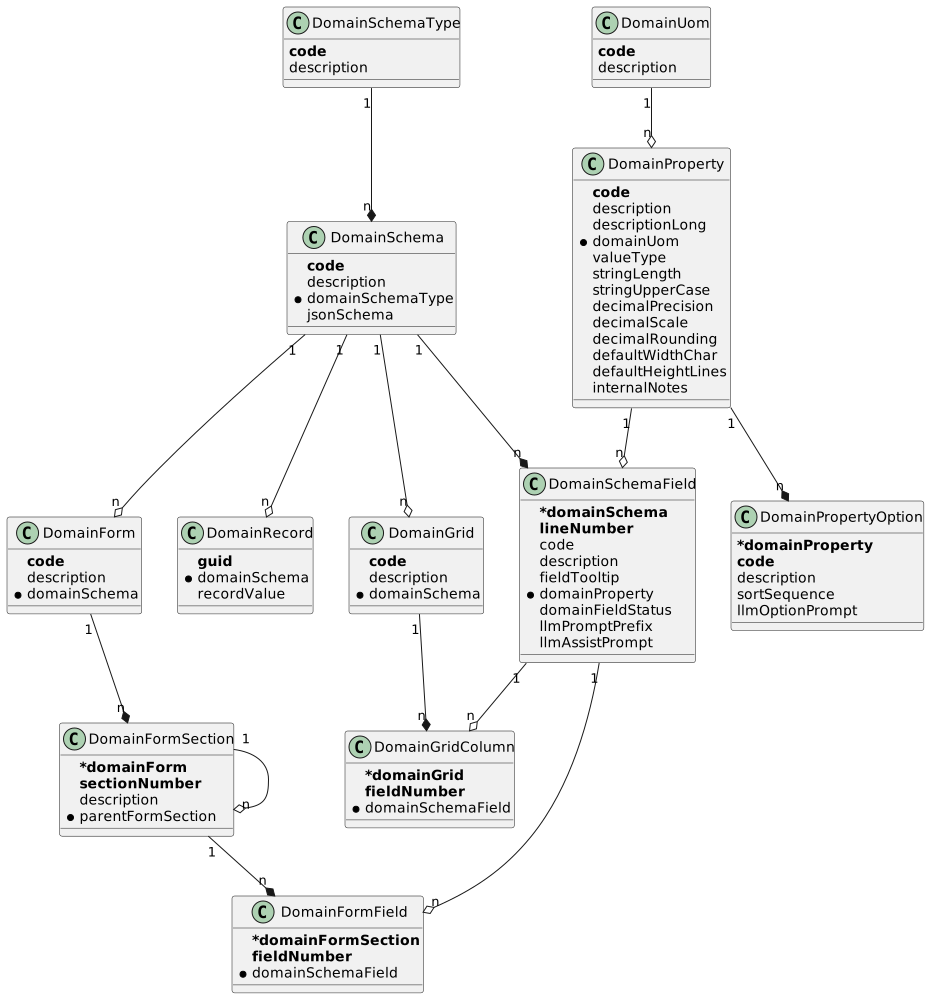
Domain Schema Type (DomainSchemaType)
Top-level category that groups related schemas (for example "marketing", "trade").
| Field | Description |
|---|---|
| Business key (up to 12 characters). |
| Human-readable name. |
Domain Schema (DomainSchema)
The structural definition of a record type. A schema belongs to a DomainSchemaType and owns an ordered set of schema fields. At runtime it is converted to an io.venlo.domain.dictionary.DictionarySchema so the framework can read, write, and validate values.
| Field | Description |
|---|---|
| Business key (up to 12 characters). |
| Human-readable name. |
| Type/category the schema belongs to. |
| Optional JSON Schema document; reserved for external schema export/validation. |
| Operational back-reference to the fields that make up this schema. |
Domain Schema Field (DomainSchemaField)
One field of a schema. It binds a DomainProperty for typing rules and adds schema-specific concerns such as ordering, labels, mandatory/optional status, and LLM-assist prompts.
| Field | Description |
|---|---|
| Owning schema (business key, plus |
| Order of the field within the schema. |
| Field code (up to 24 characters), used as the JSON key in records. |
| Field label shown in forms and grids. |
| Optional tooltip shown next to the field. |
| The typed property providing value rules and (for enumerates) options. |
| Whether the field is inactive, mandatory, or optional. |
| Optional short text prepended to the LLM prompt when this field is filled by AI. |
| Optional full prompt used when an LLM is asked to fill this field for a record. |
The lookup DomainSchema.getField(code) returns the schema field for a given field code, or raises a business exception if it does not exist.
Domain Property (DomainProperty)
A reusable typed value descriptor. Multiple schema fields can share the same property to keep typing rules consistent across schemas.
| Field | Description |
|---|---|
| Business key (up to 12 characters). |
| Short label. |
| Longer description used in tooltips and AI context. |
| Optional unit of measure (e.g. for decimal properties). |
| The kind of value this property holds — see Value Types below. |
| Maximum length for |
| Whether |
| Total digits for |
| Digits after the decimal point for |
| Rounding mode applied to |
| Default editor width in characters (for text-style values). |
| Default editor height in lines (for text-style values). |
| Free-form notes for administrators; not shown to end users. |
Value Types (DomainValueType)
| Code | Name | Meaning |
|---|---|---|
| Boolean | True/false flag. |
| Date | Calendar date. |
| Date Time | Date plus time of day (minute precision). |
| Decimal | Fixed-precision number; uses |
| Enumerate | One value chosen from this property’s |
| Integer | 32-bit integer. |
| Json | Raw JSON value. |
| Long | 64-bit integer. |
| Short | 16-bit integer. |
| String | Single-line text; uses |
| Ascii | Multi-line plain ASCII text. |
| Css | Multi-line CSS source. |
| Html | Multi-line HTML source. |
| JavaScript | Multi-line JavaScript source. |
| Markdown | Multi-line Markdown source. |
| CSV | Multi-line CSV content. |
| Reference | Reference to another entity (reserved; not currently materialized as a record value). |
Domain Property Option (DomainPropertyOption)
An allowed value for an enumerate property. Options also carry an optional LLM prompt that helps an AI assistant pick the option for a field.
| Field | Description |
|---|---|
| Owning property (business key, plus |
| Option code (up to 4 characters), persisted as the field value. |
| Human-readable label for the option. |
| Optional ordering hint for the option list. |
| Optional prompt segment used when an LLM evaluates whether to pick this option. |
Domain Unit of Measure (DomainUom)
A unit attached to numeric or text properties to clarify what the value represents (for example "kg", "%", "min").
| Field | Description |
|---|---|
| Business key (up to 8 characters). |
| Human-readable name. |
Domain Form (DomainForm)
A user-interface layout that captures data for one schema. A form has one or more sections, which can themselves nest.
| Field | Description |
|---|---|
| Business key (up to 12 characters). |
| Human-readable name. |
| The schema whose fields this form lays out. |
Domain Form Section (DomainFormSection)
A section within a form — visually a fieldset/group. Sections can be nested via parentFormSection.
| Field | Description |
|---|---|
| Owning form (business key, plus |
| Order of the section within the form. |
| Section title displayed in the UI. |
| Optional parent section, enabling nested groups. |
Domain Form Field (DomainFormField)
One field placement inside a section. It points at a DomainSchemaField; the section’s order plus fieldNumber determine where it appears on screen.
| Field | Description |
|---|---|
| Owning section (business key, plus |
| Order of the field within the section. |
| The schema field rendered at this position. |
Domain Grid (DomainGrid)
A table layout used to list records of a schema.
| Field | Description |
|---|---|
| Business key (up to 12 characters). |
| Human-readable name. |
| The schema whose fields this grid columns are taken from. |
Domain Grid Column (DomainGridColumn)
One column placement within a grid.
| Field | Description |
|---|---|
| Owning grid (business key, plus |
| Order of the column from left to right. |
| The schema field shown in this column. |
Domain Record (DomainRecord)
A concrete data instance for a schema. The values are stored as JSON in recordValue; the schema interprets the JSON into typed values when the record is read.
| Field | Description |
|---|---|
| Globally-unique business key. |
| The schema this record conforms to. |
| JSON document containing the record’s field values, keyed by schema-field code. |
Domain Field Status (DomainFieldStatus)
| Code | Name | Meaning |
|---|---|---|
| Inactive | The field exists but is hidden from data entry and listings. |
| Mandatory | The field must be filled when entering data. |
| Optional | The field may be left empty. |
Functionality
Schema-to-Dictionary conversion
DomainSchemaConverter.toDictionarySchema(…) (exposed via SYS_FRM_Util.toDictionarySchema) converts a DomainSchema into a Venlo DictionarySchema. For each schema field it derives a typed ValueTypeMeta from the field’s DomainProperty — for example, String properties become a StringMeta carrying the property’s length and upper-case flag, and Decimal properties become a DecimalMeta carrying precision, scale, and rounding mode. The resulting DictionarySchema is what the rest of the framework uses to read, write, and validate record values.
Reference (R) properties are not currently convertible and raise an internal exception if encountered; they are reserved for future cross-entity references.
Domain record creation
DomainRecordWriterService.createDomainRecord(schema, recordValue) creates a new DomainRecord with a fresh GUID, links it to the supplied schema, and persists it. The caller is responsible for producing a JSON DomainRecordValue whose keys match the schema’s field codes.
JSON record-set wrappers
Two helper classes simplify reading and writing record-set JSON in service code:
JsonValueMapListWrapperParses a JSON array of objects into a mutable list of
Map<String, Object>. Provides record-level access by index (getValue,setValue,addRecord) and serialization back to JSON. Used when typing rules are not needed.JsonDictionaryListWrapperWraps a
JsonValueMapListWrapperwith aDictionarySchema.getValueandsetValuego throughDictionaryUIConverterso callers exchange typed Java values (e.g.BigDecimal,LocalDate) instead of raw JSON primitives. This is the standard way to manipulate record values once a schema is available.
LLM-assist prompt construction
DomainSchemaReaderService.createDomainSchemaFieldAssistPrompt(…) is the entry point for building the prompt that asks an LLM to fill a single field of a record, using the field’s llmPromptPrefix, llmAssistPrompt, and any enumerate option’s llmOptionPrompt. The current implementation returns an empty string and is a placeholder for the upcoming LLM-driven form-filling feature.
Public API
SYS_FRM_QueryApi
Read-side facade for other modules.
| Method | Description |
|---|---|
| Returns the schema with the given code, or |
| Same as above but raises a business exception if not found. |
| Delegates to |
SYS_FRM_CommandApi
Write-side facade for other modules.
| Method | Description |
|---|---|
| Persists a new record under the given schema and returns it. |
SYS_FRM_Util
Static utility for converting a DomainSchema to a Venlo DictionarySchema. Used wherever the framework needs to render or validate record values for a schema.
| Method | Description |
|---|---|
| Returns the framework |
SYS_FRM_Constant
Currently contains no constants.
ViewModel actions
The submodule defines view models (DomainSchemaViewModel, DomainPropertyViewModel, DomainFormViewModel, …) for the standard CRUD pages, but does not declare any custom UI actions. There are no buttons specific to this submodule beyond the default toolbar.