
Blog Wercstat
The AI math for legacy software has fundamentally changed
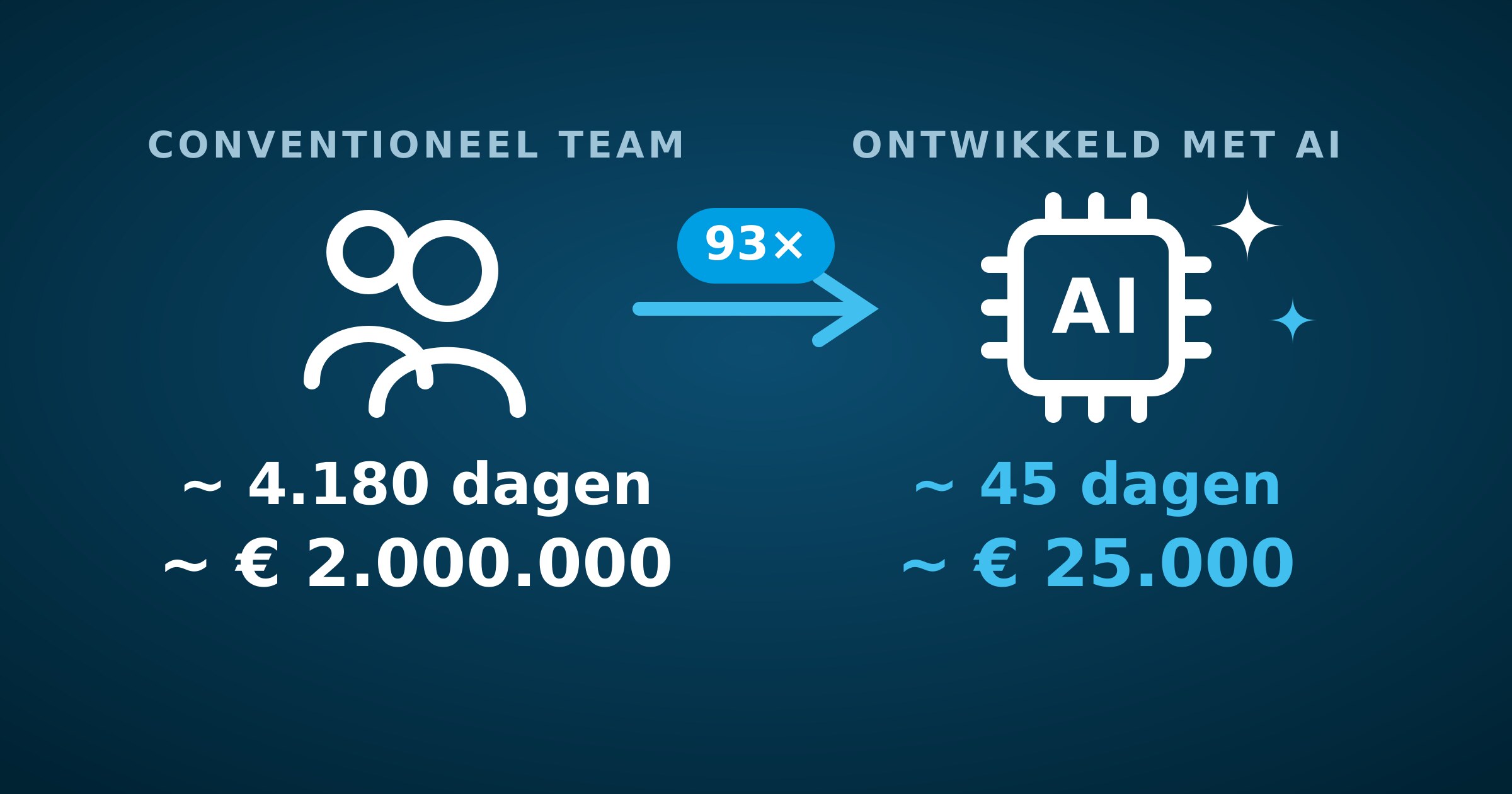
AI has become much better in recent months at understanding and generating complex code. .NET architect David Tielke rebuilt a legacy application entirely with AI: up to 93x faster and for € 25,000 instead of an estimated € 2 million. With the necessary nuance for large enterprise software, the boundary is unmistakably shifting, and with it the math for modernising outdated custom software.
Companies still running on outdated custom software now have to seriously ask themselves whether it is time to modernise. The math for deploying Artificial Intelligence (AI) in software development has fundamentally changed this year.
We recently wrote about the rise of 'vibe coding' and how AI tools such as Claude Code are shaking up the market. AI has simply become much better in recent months at understanding and generating complex code.
The experiment: a business application fully rebuilt by AI
That rapid progress prompted .NET architect and software adviser David Tielke to put it to the test. He decided to fully modernise an existing, administrative legacy application. The hard requirement: all code had to be written by AI, but based on professional enterprise quality standards and a tight architecture.
The results that startled even him:
Extreme acceleration: a development speed 25x to 93x higher than a conventional development team. The 93x is the raw realised speed; the 25x is the conservative estimate after all caveats are taken into account.
Enormous cost reduction: the project ultimately cost € 25,000 (including all AI token costs) instead of an estimated € 2,000,000 in traditional development hours.
| The acceleration is based on an estimate of the hours conventional software development would have cost. |
The nuance with enterprise software
Naturally, a realistic caveat is in order here. Many enterprise applications within larger organisations are still many times larger than the application from this experiment. On top of that, they often contain complex, sector-specific logic that is not simply part of an AI model’s standard training set.
We have said before that AI does not yet build large-scale software fully independently. We stand by that for now; human expertise, architectural knowledge and business logic remain indispensable. But the boundary is unmistakably shifting.
The moment to sever the legacy ties
If outdated custom software is holding back your business’s growth, then now is the moment to modernise. AI can take over a large part of the development work.
And however good AI is, the success of a project comes down to who guides it: professional developers who know the domain, articulate the client specification precisely and continuously steer the AI. Especially on larger projects, that makes all the difference. AI speeds up the work, people determine the outcome. We explain how we tackle that on our approach page.
Curious how AI can bring your legacy software into the modern era faster? Feel free to get in touch with Wercstat for a no-obligation exploration of the possibilities. |